
Most people assume bed bugs are a bedroom problem. Then one morning you wake up with bites on the back of your thighs after a Netflix session on the couch, and suddenly that assumption falls apart.
Bed bugs will absolutely set up in your sofa. It’s warm, it has crevices everywhere, and you sit on it for hours every day – basically a perfect feeding station. The good news is that getting rid of bed bugs in a couch is very doable if you hit it with the right methods in the right order.
How to Get Rid of Bed Bugs in a Couch: Your Treatment Plan
A couch is harder to treat than a mattress because of the number of hidden seams, the frame cavity underneath, and the layered fabric construction. One method alone is rarely enough. The approach that actually works combines multiple treatments applied in sequence.
Step 1 – Vacuum the Entire Couch Thoroughly
This is your first pass, not your fix. Vacuuming removes live bugs, nymphs, and loose eggs from the surface – reducing the population before you apply heat or chemicals.
Use a crevice tool attachment and go slowly. Work into every seam, under every fold, along every zipper, and around the frame joints. Don’t rush this step.
After you’re done, immediately remove the vacuum bag and seal it in a plastic bag before tossing it outside. If you have a bagless vacuum, empty the canister directly into a sealed bag outdoors and wipe the canister with a damp cloth. Leaving bug-filled vacuum contents inside your home defeats the purpose.
Step 2 – Heat Treat Everything Removable
Any cushion covers, throw blankets, or slipcovers that can come off the couch go straight into the dryer on the highest heat setting for at least 30 minutes. This kills every life stage – adults, nymphs, and eggs.
Wash them in hot water first if they’re visibly soiled, but the dryer is the actual kill step here. Temperature matters, not the wash cycle.
For items that can’t go in the dryer – decorative pillows with non-washable covers, delicate fabric cushion covers – a handheld clothes steamer run slowly over the surface at close range will kill bugs on contact. The steam needs to reach at least 130°F at the surface to be effective.
Check out my detailed post on DIY bed bug heat treatment for the full process.
Step 3 – Steam the Couch Frame and Upholstery
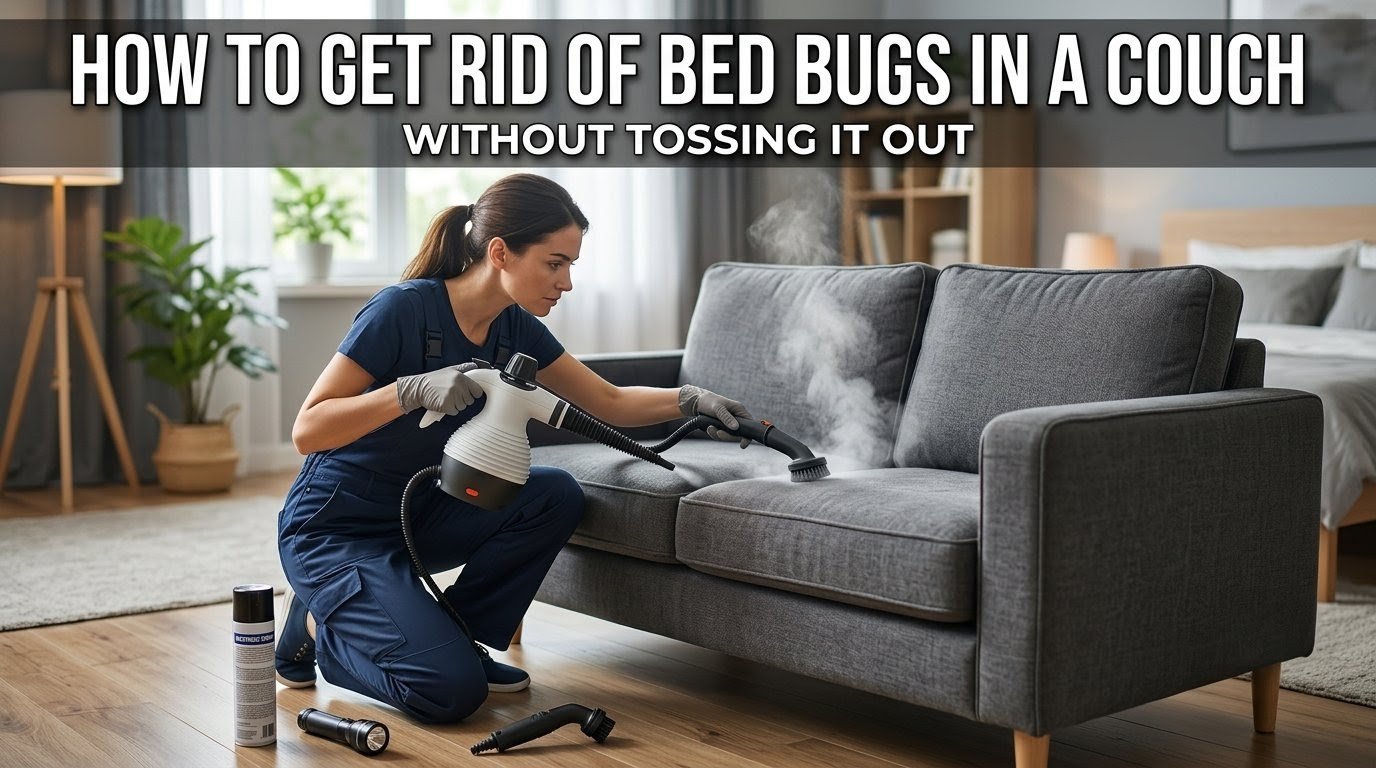
This is the most important step for the couch itself. A clothes steamer or a steam cleaner with an upholstery attachment kills bed bugs and eggs on contact – and it’s safe for most fabric types.
The EPA recommends a steam temperature of at least 130°F applied slowly to surfaces, with a diffuser attachment if available to prevent scattering bugs with forceful airflow.
Work the steamer slowly across:
- All upholstered surfaces
- Every seam and fold
- Under the cushion bases
- Along the wooden or metal frame underneath
- The dust cover on the bottom (remove it if possible to steam underneath)
Move the steamer at about 1 inch per second – slower than feels necessary. If you rush, the surface dries before heat penetrates deep enough to kill anything hiding just below the fabric.
Let the couch dry completely before the next step. Applying products to damp fabric reduces their effectiveness.
Step 4 – Apply Diatomaceous Earth in the Frame Cavity
Once the couch is dry, apply food-grade diatomaceous earth (DE) – specifically a product carrying an EPA registration number – inside the frame cavity of the couch. This is the hollow space underneath and inside the body of the couch that you can access by removing the dust cover.
DE is a mechanical killer. Its microscopic particles cut through bed bugs’ waxy exoskeleton, causing them to dehydrate and die over the following days. It has no chemical resistance risk because it kills physically, not chemically.
A few important points: use the registered pesticide version, not pool-grade or unregistered DE. The EPA specifically notes that unregistered diatomaceous earth can harm you if inhaled. Apply it as a light dusting – not a visible pile – in cracks and enclosed spaces inside the frame. Don’t broadcast it over sitting surfaces.
Leave it undisturbed for at least 7 to 14 days. Any bugs that survived the steam and are moving through the frame will walk through it.
Step 5 – Apply an EPA-Registered Contact Spray
For any remaining bugs and as a residual barrier, apply an EPA-registered insecticide spray labeled for use on upholstered furniture. Look for products with one of these active ingredients:
- Pyrethrins or pyrethroids (such as permethrin) – the most widely available and effective for bed bugs on contact. Note that some bed bug populations have developed resistance to pyrethroids, so if you’ve used them repeatedly without success, switch classes.
- Chlorfenapyr – a pyrrole insecticide that works by disrupting cellular energy in bed bugs. Works on pyrethroid-resistant populations.
- Cold-pressed neem oil – the only biochemical pesticide the EPA has registered for bed bugs. Controls adults, nymphs, and eggs. A better option if you have pets or children and want to minimize chemical exposure on furniture.
Always check that the label specifically permits use on upholstered furniture before applying. Spray into seams, folds, and along the frame edges. Do not saturate the fabric – a light, targeted application is what you want. Let it dry fully before anyone sits on the couch.
Pro tip: Don’t use foggers (bug bombs) to treat a couch or any furniture. The EPA is direct about this: foggers don’t reach into crevices where bed bugs hide, and the fine mist can scatter bugs deeper into the structure. You’ll make the infestation harder to treat, not easier.
Step 6 – Use Interceptor Traps Under Couch Legs
Place bed bug interceptor traps under each leg of the couch. These are low-profile plastic dishes with a textured outer surface and a smooth inner well – bugs can climb in but can’t climb out.
They serve two purposes: they catch bugs trying to reach you from the floor, and they tell you whether your treatment is working. If you’re catching live bugs in the traps two weeks after treatment, you haven’t finished the job yet.
Should You Throw Away a Bed Bug-Infested Couch?
This is a common question, and the answer is almost always no – unless the infestation is severe and the couch is very old or cheap to replace.
Throwing out an infested couch doesn’t solve the problem if bugs have spread to other furniture, the carpet, or baseboards in the room – which they often have by the time you notice them on the couch. You’ll spend money replacing furniture and still have bugs.
Treat first. Replace only if the couch is structurally compromised, the infestation is genuinely out of control after multiple treatments, or the construction makes thorough treatment impossible (like a couch with a solid foam base and no removable parts).
If you do throw it out, wrap it completely in plastic sheeting and mark it “BED BUGS” in spray paint before putting it outside. This prevents someone else from picking it up and re-infesting their home – and then potentially yours.
Preventing Bed Bugs from Coming Back
Getting rid of bed bugs in a couch is only half the fight. The other half is making sure they don’t come back from another source.
A few things that actually help:
- Inspect secondhand furniture before it enters your home. Most couch infestations come from used furniture, moving trucks, or infested hotel rooms transferred through luggage.
- Keep the area around your couch clear. Clutter gives bugs more places to hide and makes inspections and treatments harder.
- Vacuum the couch regularly, including the seams and underneath, especially after guests visit.
- Check your bedroom too. If you found bugs in the couch, there’s a real chance they’re in your bed as well. A couch infestation and a clean bedroom is possible, but don’t assume it.
When the Couch Is Beyond DIY Treatment
Most single-couch infestations caught early respond well to the steps above. Call a professional if:
- You’ve treated twice and still find live bugs after two weeks each time
- Bugs have spread beyond the couch to multiple rooms
- You live in an apartment and suspect the infestation is coming through shared walls
A pest management professional has access to professional-grade residual sprays and heat treatment equipment that cover an entire room simultaneously – not just the furniture surface.
You Can Handle This
Bed bugs in a couch are stressful, but they’re not a death sentence for the furniture. Steam, diatomaceous earth, a registered insecticide, and interceptor traps used together give you a solid shot at clearing this up without spending a dollar on a professional.
Be thorough, be patient, and monitor those traps. If you catch nothing in them after two to three weeks and you’re not getting new bites, you’re likely in the clear.